Healing Begins With Relationship
For much of modern history, healing has largely been understood as the reduction of symptoms.
While symptom relief is deeply meaningful, I believe it represents only one aspect of a much larger process.
The Restoration of Human Relationship proposes that beneath many forms of psychological suffering lies a more fundamental disruption: the interruption of relationship itself.
Not only relationship with others, but relationship with the body, emotions, memory, nature, meaning, and the direct experience of being alive.
Healing, then, is not simply the removal of pain.
It is the gradual restoration of relationship.
The Central Premise
At its foundation, this framework proposes a simple shift:
Human beings are inherently relational.
We are not isolated minds navigating the world. Every aspect of our experience unfolds through relationship.
We exist in relationship with:
- the body
- emotions
- thoughts
- memory
- other people
- nature
- mystery
When relationship is interrupted, fragmentation follows.
Healing itself is the restoration of relationship.
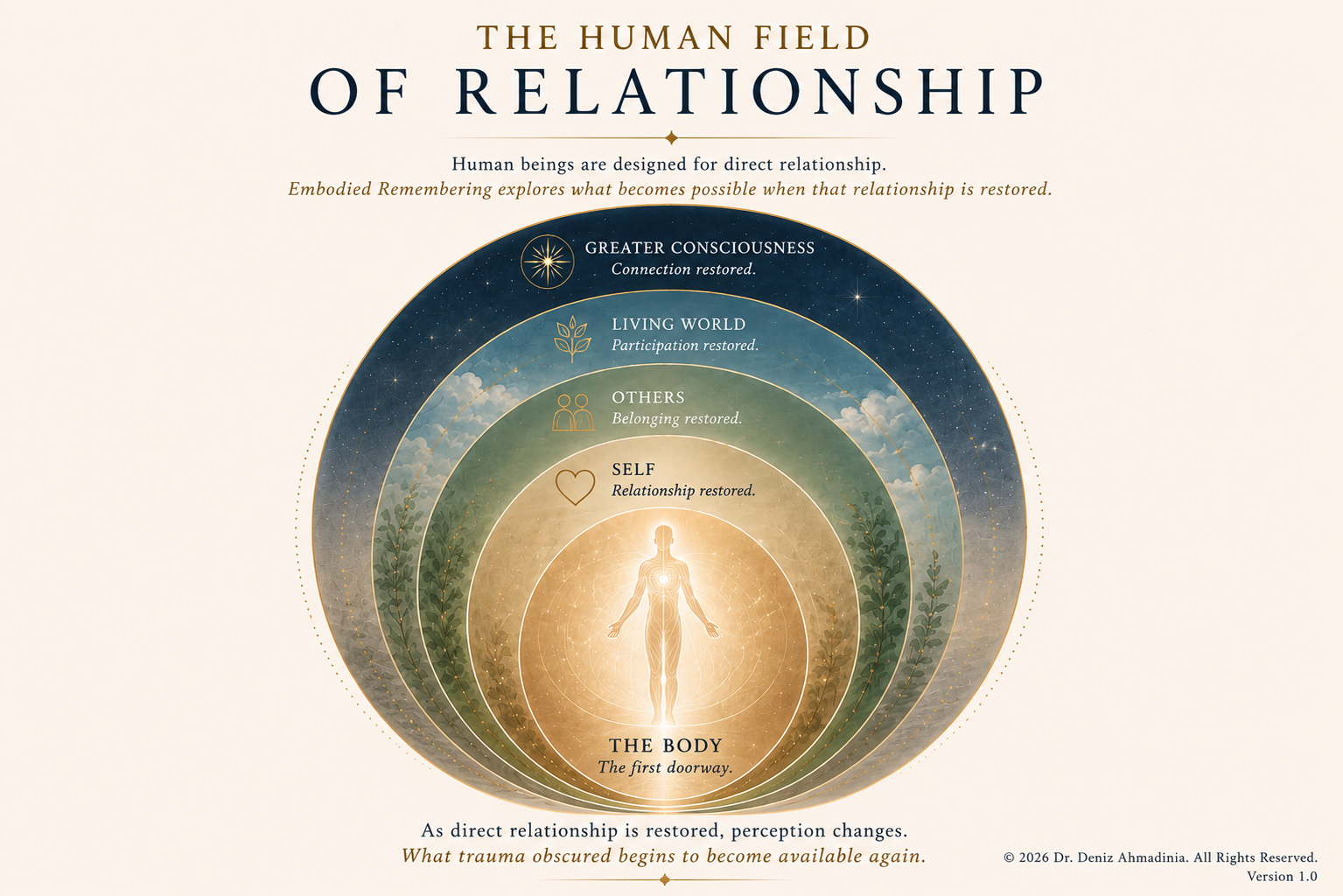
Human Relationship as a Living Field
Relationship is not a single connection.
It is a living field.
Each dimension continually influences every other.
When one relationship becomes disrupted, the effects often ripple throughout the entire system.
Likewise, restoring relationship in one domain frequently creates movement throughout the whole.
Healing therefore does not occur in isolated parts. It unfolds through the restoration of the entire relational field.
Fragmentation
Trauma, chronic stress, attachment disruption, and environments organized around fear often require us to disconnect from aspects of direct experience in order to survive.
This adaptive process can gradually narrow the range of relationships available to us.
We may become disconnected from:
- our bodies
- our emotions
- our intuition
- our needs
- our memories
- our capacity for trust
- our sense of belonging
- our relationship with life itself.
These adaptations are not failures.They are intelligent responses to overwhelming circumstances.
Yet over time, what once protected us can also limit our capacity to experience life directly.
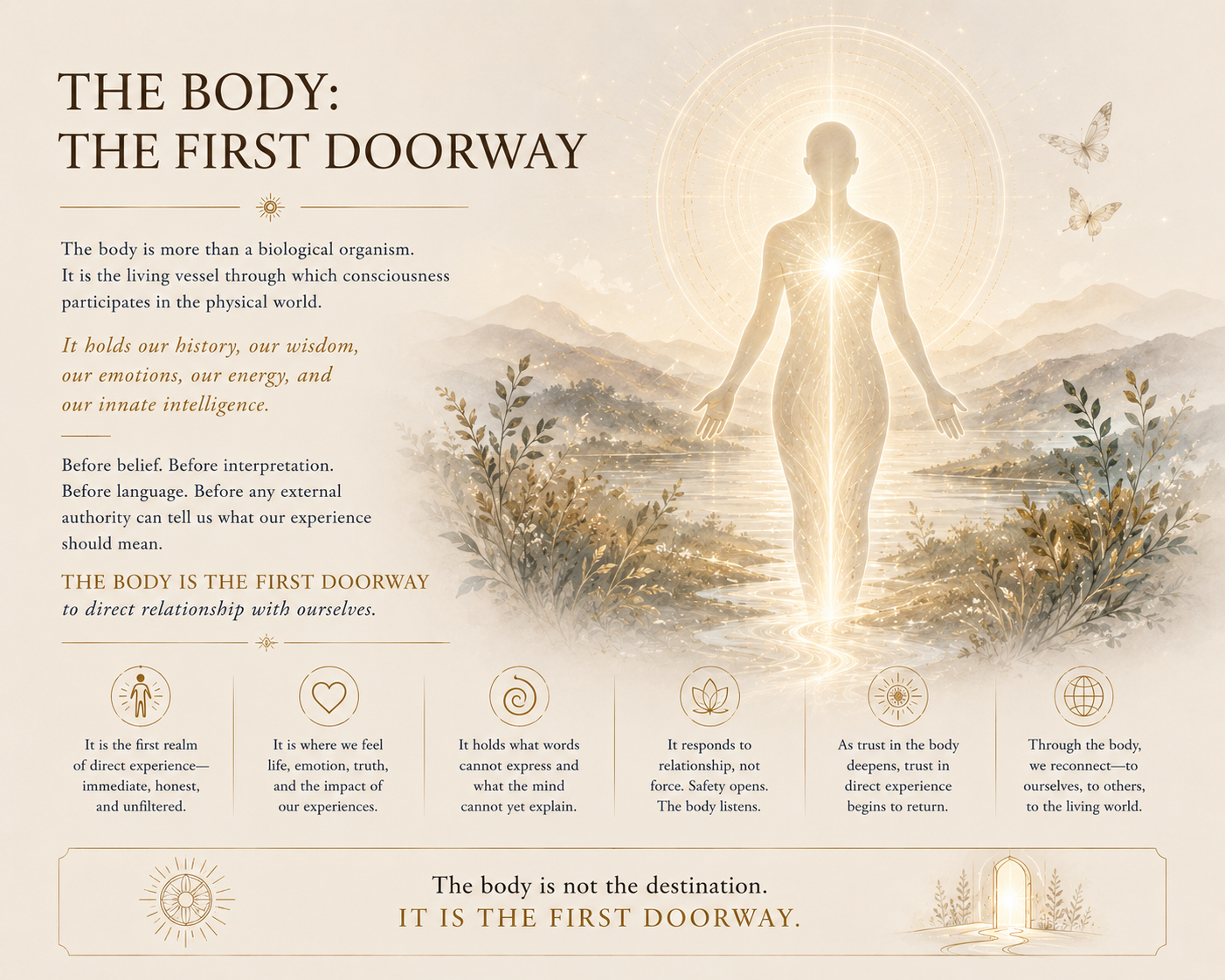
The body is the doorway through which forgotten aspects of ourselves can be experienced and remembered.

Restoration & Repair
Many healing models are organized around the idea of fixing what is broken.
This framework begins from a different assumption.
Rather than asking, "What is broken?" it asks, "What relationship has been interrupted?"
This subtle shift changes the orientation of healing itself.
The work becomes less about correcting the person and more about restoring connection.
Relationship Precedes Remembering
One of the central observations that gave rise to this framework is that remembering cannot be forced.
It unfolds through relationship.
As safety deepens...
new experiences become accessible.
As trust develops...
forgotten aspects of ourselves emerge.
As relationship strengthens...
our capacity for perception expands.
The order matters.
Relationship precedes remembering.
Remembering precedes integration.
"Healing is not becoming someone new.
It is remembering who you have always been."
Beyond Symptom Reduction
Psychological symptoms matter.
Relief matters. Healing & recovery from trauma matters.
This framework does not seek to replace those goals.
Rather, it asks whether symptom reduction may sometimes be one expression of something even deeper:
the restoration of relationship itself.
As relationship expands, people often discover increased resilience, meaning, creativity, intuition, authenticity, and connection—not because these capacities are added, but because they gradually become available again.

Ongoing Inquiry
This framework is not presented as a closed system.
It is an evolving inquiry informed by clinical psychology, attachment theory, trauma research, somatic practice, contemplative traditions, and lived experience.
Some aspects are grounded in established psychological science.
Others remain active questions that continue to unfold through observation, reflection, and dialogue.
I do not see this work as arriving at final answers.
I see it as participating in an ongoing exploration of what becomes possible as human relationship is restored.
Continue Exploring...
Embodied Remembering™
Lorem ipsum dolor sit amet, metus at rhoncus dapibus, habitasse vitae cubilia odio sed. Mauris pellentesque eget lorem malesuada wisi nec, nullam mus. Mauris vel mauris. Orci fusce ipsum faucibus scelerisque.